Residential
Positive Drive Villa Elevator
Counterweight-free drive train that works in the smallest shafts, with 48 dB machine noise.
View Details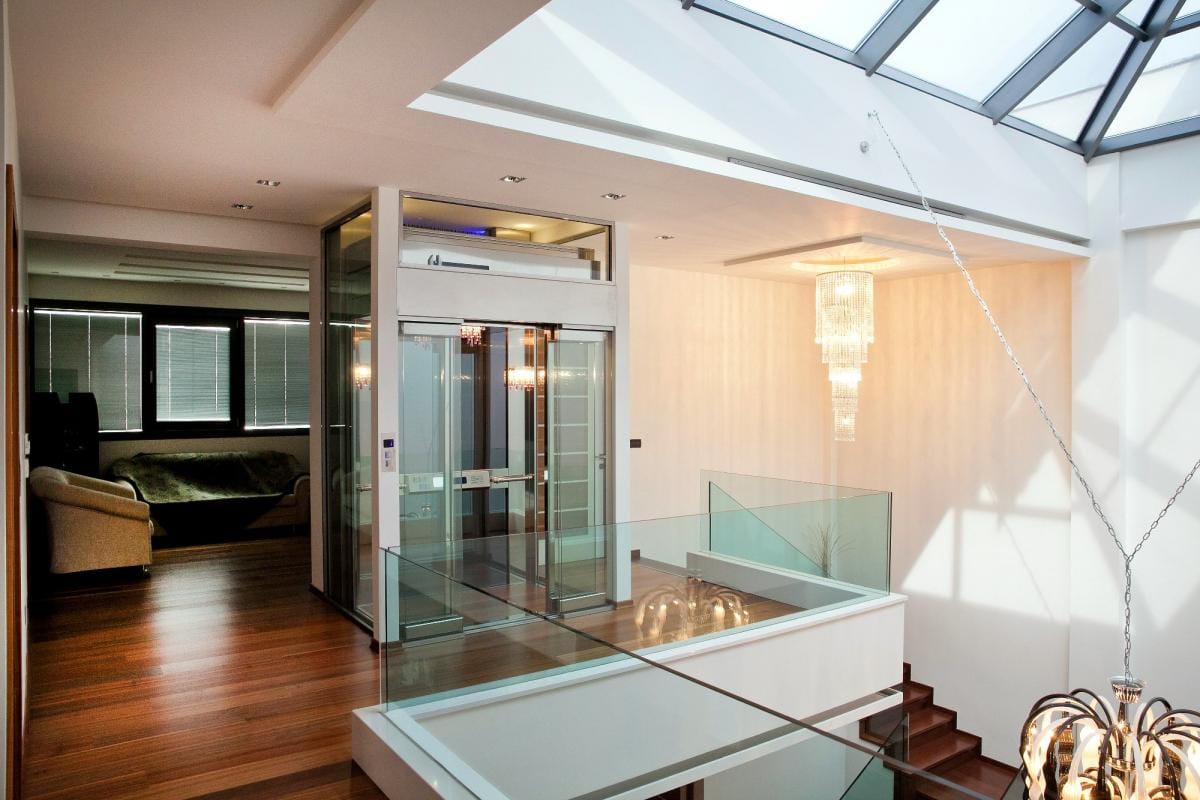
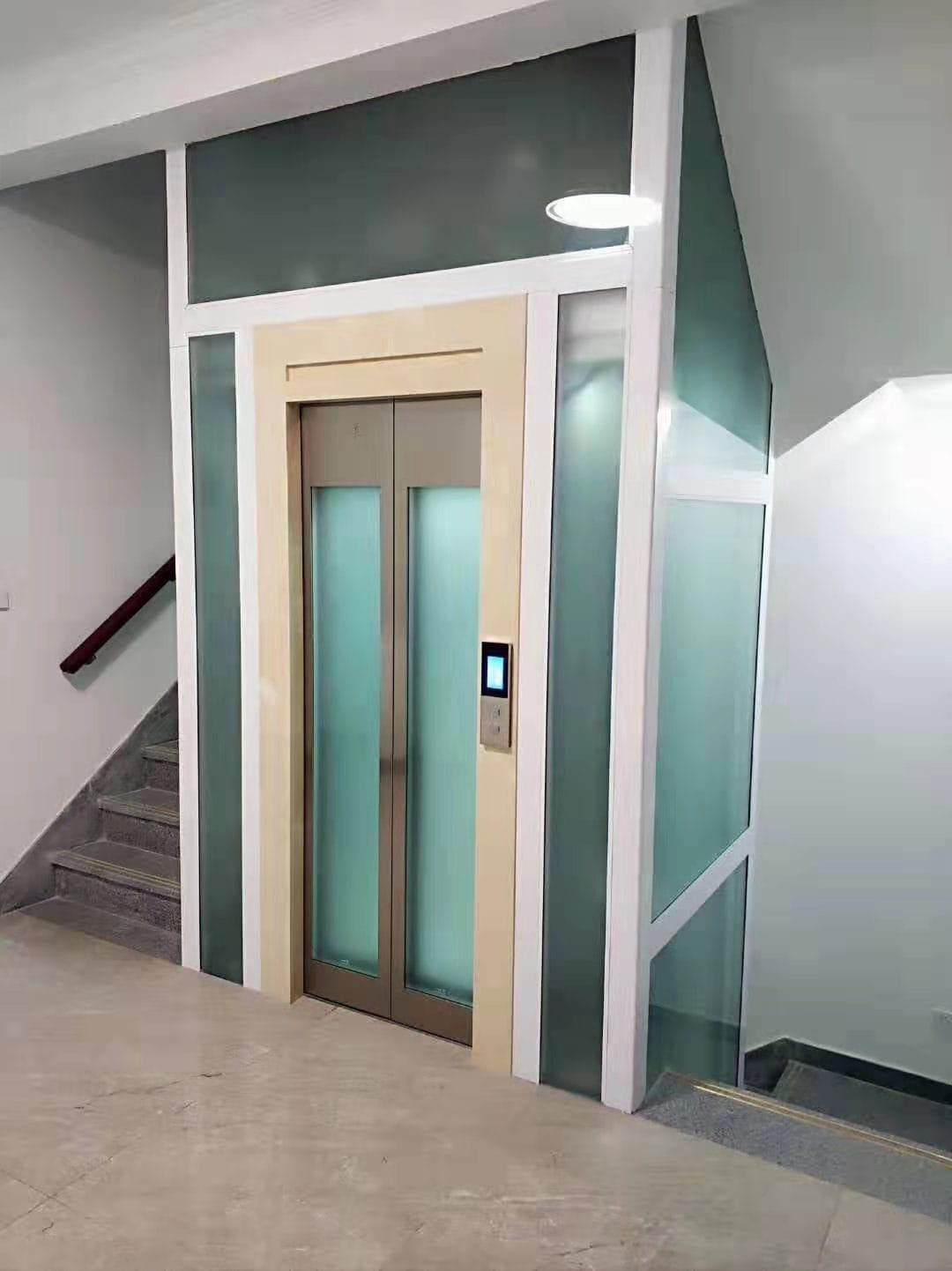
The traction villa elevator is our most widely specified residential model. It drives the car with a purpose-built permanent-magnet traction machine and a VVVF inverter, so acceleration and levelling stay smooth even at walking pace. Available with or without a machine room, and with either a backpack frame or a gantry frame, it adapts to the geometry of an existing staircase rather than demanding that the house be rebuilt around it.
The most common reason a villa lift project stalls is that the shaft does not exist — or exists in a shape the standard product cannot use. The traction villa elevator is therefore supplied as a family of frame variants rather than one fixed geometry.
With a backpack frame the guide rails sit behind the car, so car depth is added to shaft depth while shaft width stays minimal. With a gantry frame the rails sit to both sides, giving a wider car for the same shaft footprint. Both accept hinged or sliding landing doors, and both can be installed inside an existing stairwell void, an external shaft or a self-supporting steel tower.
| Parameter | Value |
|---|---|
| Rated capacity | 250 kg / 320 kg / 400 kg (3–5 persons) |
| Rated speed | 0.4 m/s (0.3 m/s option) |
| Max. travel | up to 6 stops / 18 m |
| Drive system | Permanent-magnet gearless traction, VVVF |
| Control | Residential microcomputer board, serial communication |
| Power supply | AC 220 V single phase or AC 380 V three phase |
| Rated running power | approx. 1.5 kW (drive 1.1 kW) |
| Machine room | MRL standard; machine-room version optional |
| Car frame | Backpack (rear rails) or gantry (side rails) |
| Shaft minimum | 1,200 × 1,200 mm (model dependent) |
| Headroom minimum | 2,800 mm (model dependent) |
| Pit depth | 300 mm (model dependent) |
| Doors | Automatic centre-opening VVVF; manual hinged option |
| Car finishes | Hairline / mirror stainless steel, wood-grain laminate, tempered glass |
| Safety devices | Over-speed governor, safety gear, ARD, door-zone detection |
| Emergency | One-touch auto-dial telephone (3–5 numbers), alarm bell |
| Standards | Chinese Class-A licence; EN 81-20/50 engineering on request |
Values shown are typical for the standard configuration. Final data are confirmed on the approved layout drawing for each project.
A home lift is judged by how it sounds at night. Three measures keep this model quiet: a microcomputer board written specifically for the residential duty cycle, a machine frame fixed directly to the guide rails so the building structure carries no load, and inverter-controlled doors that remove the slam of a conventional operator.
Total rated running power is approximately 1.5 kW, of which the drive accounts for 1.1 kW — less than a microwave oven, and around 80% lower than a commercial small lift of the same capacity. Because the machine accepts a single-phase 220 V household supply, no industrial power application is needed before installation.
An ARD (automatic rescue device) is fitted as standard. When the supply fails, the ARD drives the car to the nearest landing and opens the doors so passengers can step out — a requirement in most residential codes and simple peace of mind in a family house.
A one-touch emergency telephone auto-dials three to five family numbers in sequence, and the optional remote module forwards running status and fault codes to the owner's phone, so a minor door fault is reported before it becomes a stranded car.
Typical values for the standard configuration. Options and project-specific variants are confirmed on the approved layout drawing.
| Parameter | Standard value / option |
|---|---|
| Rated capacity | 250 kg / 320 kg / 400 kg (3–5 persons) |
| Rated speed | 0.4 m/s (0.3 m/s option) |
| Max. travel | up to 6 stops / 18 m |
| Drive system | Permanent-magnet gearless traction, VVVF |
| Control | Residential microcomputer board, serial communication |
| Power supply | AC 220 V single phase or AC 380 V three phase |
| Rated running power | approx. 1.5 kW (drive 1.1 kW) |
| Machine room | MRL standard; machine-room version optional |
| Car frame | Backpack (rear rails) or gantry (side rails) |
| Shaft minimum | 1,200 × 1,200 mm (model dependent) |
| Headroom minimum | 2,800 mm (model dependent) |
| Pit depth | 300 mm (model dependent) |
| Doors | Automatic centre-opening VVVF; manual hinged option |
| Car finishes | Hairline / mirror stainless steel, wood-grain laminate, tempered glass |
| Safety devices | Over-speed governor, safety gear, ARD, door-zone detection |
| Emergency | One-touch auto-dial telephone (3–5 numbers), alarm bell |
| Standards | Chinese Class-A licence; EN 81-20/50 engineering on request |
A 300 mm pit is typical and some configurations require less. Where no pit can be formed we can supply a low-pit variant with a ramped entrance; tell us your slab level and we will confirm feasibility.
Yes. A backpack frame is usually the answer because the rails sit behind the car, so the lift occupies the stair void with a minimum footprint. We issue a shaft drawing for your contractor before any cutting starts.
Around 2,800 mm in the standard layout; an MRL variant with a compact machine can reduce this. Send the measured headroom and we will confirm which frame fits without structural change.
Counterweight-free drive train that works in the smallest shafts, with 48 dB machine noise.
View Details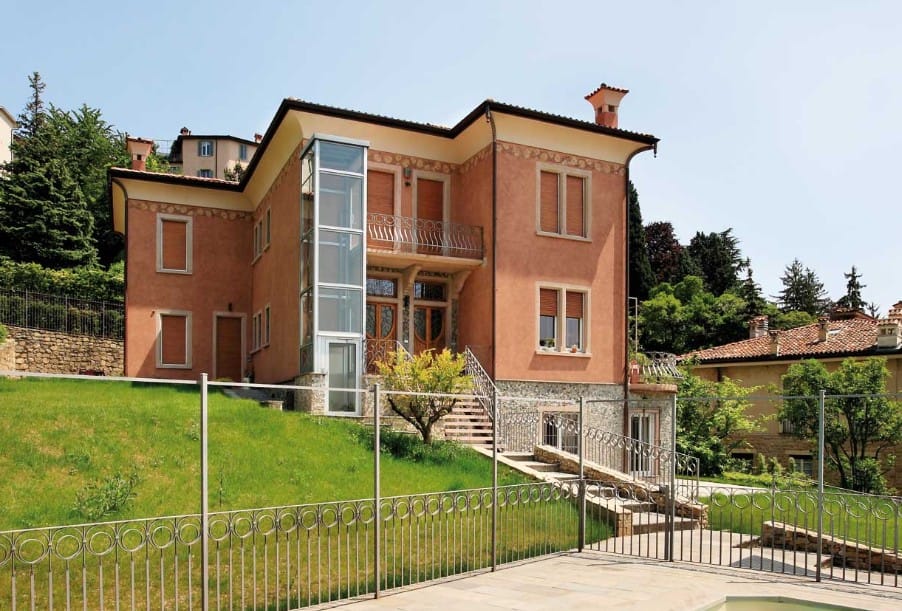
A 1,000 × 1,000 mm shaft and a 150 mm pit — for houses with almost no space.
View Details
Polyurethane belt suspension removes metal-to-metal contact, lubrication and most vibration.
View DetailsSend the shaft dimensions, floor heights and intended use. Our engineers return a layout drawing, a component specification and a delivered price — usually within one business day.